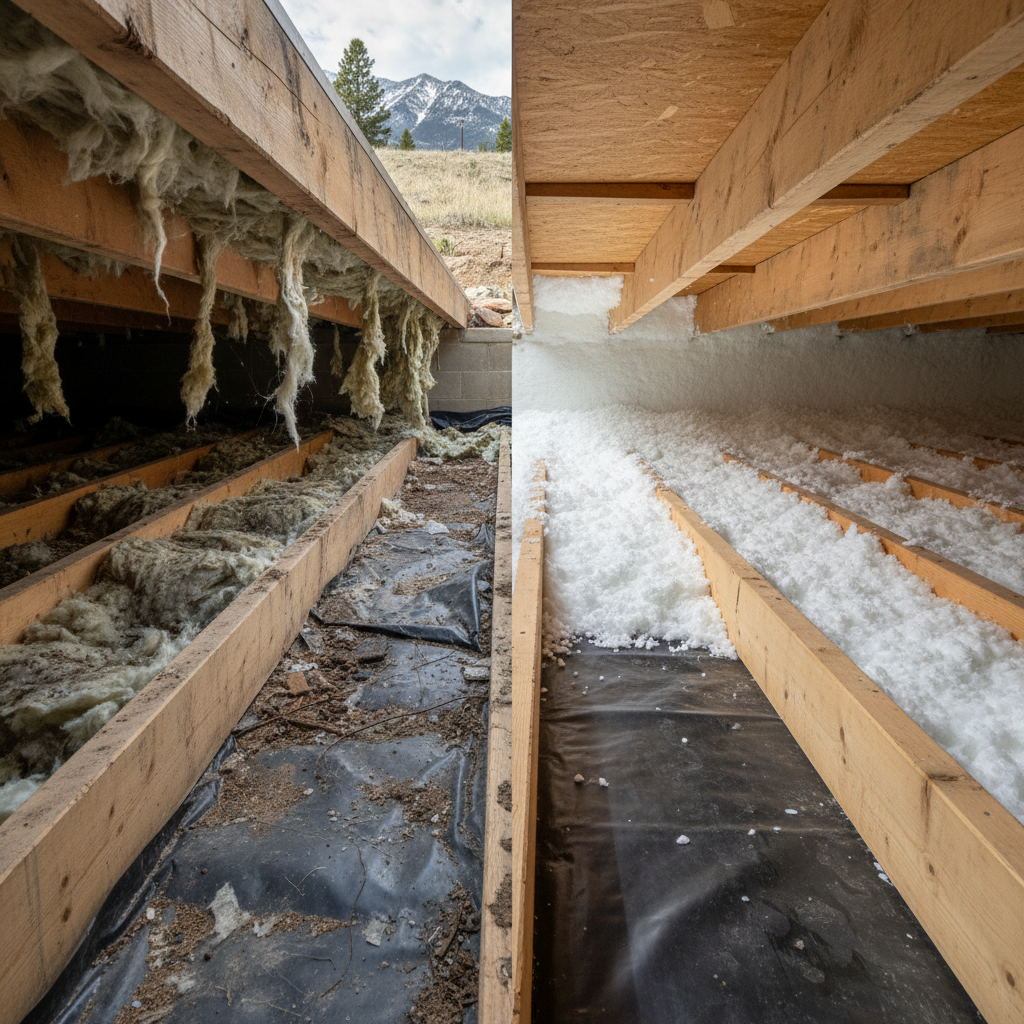
Alright, let's talk crawl spaces. If you've got one under your house here in Bozeman, you know it can be a real headache. Cold floors, high energy bills, maybe even some moisture issues. When it comes to insulating that space, you've generally got two main ways to go: traditional fiberglass batts or a full encapsulation system. I see a lot of folks wrestling with this decision, so let's clear it up.
Fiberglass Batts: The Old Standby
For years, fiberglass batts were pretty much the only game in town for crawl spaces. You'd see them stapled up between the floor joists, trying to keep the cold air out from under your living room. They're cheap, they're easy to put in, and they do offer some insulation.
But here's the thing about batts in a crawl space, especially in a place like Bozeman where we get some serious temperature swings and ground moisture: they're not really designed for that environment. Think about it. Your crawl space isn't a dry, conditioned basement. It's often damp, it can get cold, and sometimes you'll even have critters trying to make a home there.
What happens to fiberglass batts when they get damp? They sag. They get heavy. They lose their R-value, which means they stop insulating well. Once they're wet, they're basically useless, and they can even become a breeding ground for mold. I've pulled out countless soggy, moldy batts from homes in areas like the Hyalite Foothills, where groundwater can be a real factor, and it's never a pretty sight. Plus, rodents just love to nest in them, tearing them up and making an even bigger mess.
So, while the initial cost is low, the durability and long-term effectiveness of batts in a crawl space are pretty questionable. You'll likely be dealing with them again down the road.
Crawl Space Encapsulation: The Modern Solution
Now, encapsulation is a completely different beast. Instead of just trying to insulate your floor, you're treating the entire crawl space as a conditioned part of your home. This usually involves a few key steps:
- Vapor Barrier: We lay down a heavy-duty, reinforced plastic liner (often 12-mil or thicker) across the entire crawl space floor, up the walls, and around piers. This completely seals off the ground, stopping moisture from evaporating into the air.
- Sealing Vents and Air Leaks: Any open vents to the outside get sealed up. We also seal off any other air leaks between the crawl space and the outside world.
- Insulation: Instead of insulating the floor joists, we insulate the perimeter walls of the crawl space. This is often done with rigid foam board or even closed-cell spray foam, which creates a continuous thermal barrier.
- Dehumidification (Optional but Recommended): In many cases, especially if there's existing moisture, we'll put in a dedicated dehumidifier to control any remaining humidity.
The goal here is to create a dry, clean, and stable environment. You're not just insulating; you're controlling the entire climate of that space. For a company like Premium Insulation Inc., this is the gold standard for crawl spaces.
Cost, Durability, and Maintenance
Let's be upfront: encapsulation costs more upfront than just slapping up some batts. There's more material, more labor, and it's a more involved process. You're looking at a significantly higher initial investment.
However, the durability is night and day. That heavy vapor barrier isn't going to sag or get moldy. The rigid foam on the walls won't absorb moisture or get torn up by pests. An encapsulated crawl space is built to last, often for the lifetime of your home. Maintenance is minimal; you might need to clean or service a dehumidifier occasionally, but that's about it.
Appearance-wise, an encapsulated crawl space is clean, bright, and often usable for storage – something you'd never say about a traditional crawl space. It's not just about insulation; it's about transforming a nasty, neglected space into a functional one.
Why Encapsulation Wins in Bozeman
Given our climate here in Bozeman, encapsulation is almost always the better choice. We get cold winters, and while our summers aren't super humid, ground moisture is a constant battle. Snowmelt, spring rains, and even just the natural water table can lead to damp crawl spaces. Batts just can't stand up to that.
With encapsulation, you're not just getting warmer floors and lower energy bills; you're also protecting your home from moisture damage, mold, and pests. You're improving indoor air quality because you're preventing that damp, musty air from being drawn up into your living space. This is especially critical for homes built on expansive clay soils, which can hold a lot of moisture.
I've seen the difference firsthand. Homeowners who've gone with encapsulation report a noticeable improvement in comfort, a significant drop in their heating and cooling costs, and the knowledge that they don't have a damp, unhealthy space under their house. It's an investment, for sure, but it's an investment in your home's health, durability, and your family's comfort.
So, if you're weighing your options for your Bozeman crawl space, my advice is to skip the batts. They're a temporary fix at best. Go with encapsulation. You'll be glad you did.