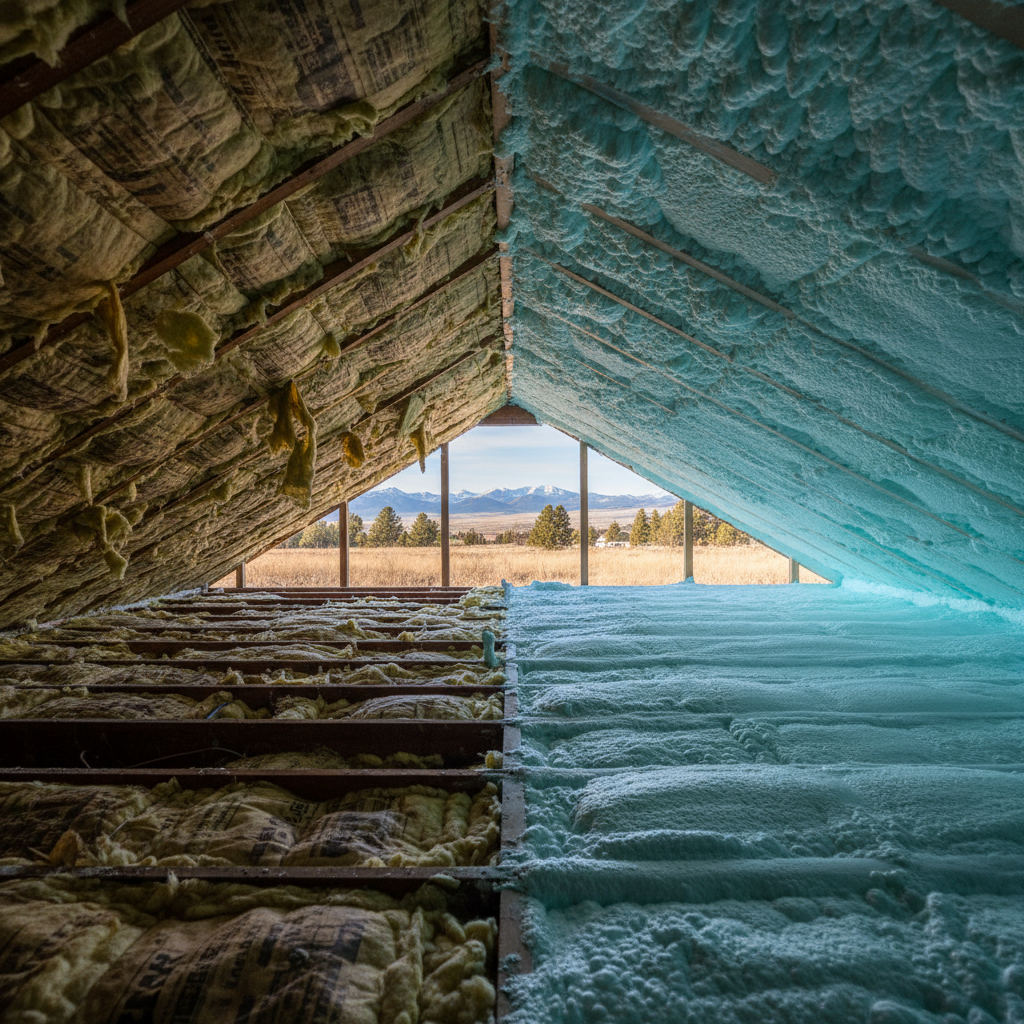
Alright, let's talk spray foam. Closed-cell, specifically. If you're thinking about insulating your place here in Bozeman, you've probably heard about it, and for good reason. It's tough, it seals up tight, and it really holds its own during our wild Montana winters. But then folks start asking me about 'flash and batt' versus 'full fill' closed-cell, and that's where things can get a little murky, you know?
I'm gonna clear that right up for you. We're actually talking about two different ways to use the same excellent product. They come with different costs, different perks, and honestly, one usually makes a lot more sense for what we deal with around here.
What's the Deal with Flash and Batt?
So, 'flash and batt' is pretty much what it sounds like. You spray a thin 'flash' layer of closed-cell foam, usually just an inch or two thick, directly onto the sheathing inside your wall cavities. The main idea here is that this thin layer creates your air seal and acts as a vapor barrier. Once that foam cures, you then fill the rest of the cavity with traditional fiberglass or rock wool batt insulation. It's kind of a hybrid system.
The big reason people go for flash and batt is usually the cost. Closed-cell foam isn't cheap, so using less of it upfront can make the project's initial price tag look a lot more attractive. You still get some of spray foam's benefits – that crucial air seal and vapor control – without paying for a full cavity of it. People often pitch it as a good middle-ground solution.
And Full Fill Closed Cell?
Full fill is a bit simpler. You just spray closed-cell foam until the whole cavity is completely packed. If you've got a 2x6 wall, that means you're getting 5.5 inches of closed-cell foam. No batts, no mixing and matching. Just pure, unadulterated closed-cell goodness, from one stud to the next.
This is how you get the absolute best performance out of closed-cell foam. You're not just sealing air; you're also getting the highest R-value per inch you can find. Plus, it really cuts down on thermal bridging through the studs because the foam is so dense and continuous. It creates a complete thermal envelope all in one go.
Cost: Where It Really Hits Home
Let's be honest, this is often the first thing homeowners want to know. Flash and batt will almost always be cheaper upfront. You're using less of the expensive stuff (the closed-cell foam) and making up the R-value difference with less costly batt insulation. Depending on the job, you could be looking at a 20-40% lower material cost compared to full fill.
Full fill, on the other hand, is a bigger investment. You're buying a lot more closed-cell foam. There's no way around that. But you're also paying for truly top-tier performance.
Performance and Durability in Bozeman
This is where the comparison really matters, especially for those of us right here in Bozeman. We see some pretty wild temperature swings, from scorching summer days to those bone-chilling January nights where it can drop to -20°F. And let's not forget that wind that just rips through the Gallatin Valley.
- Air Sealing: Both methods give you an excellent air seal. That's a core advantage of closed-cell foam. It stops drafts dead in their tracks, which makes a huge difference for comfort and your energy bills.
- R-Value: Full fill wins this one, no contest. A 2x6 wall with full fill closed-cell will give you an R-value somewhere around R-35 to R-39, depending on the specific product. Flash and batt, with, say, an R-7 per inch flash and an R-19 batt, might only get you to R-26 or R-28 total. That difference really shows up when your furnace is struggling against a deep cold snap.
- Vapor Control: Both options provide a good vapor barrier, which is super important in our climate to prevent moisture problems inside wall cavities.
- Durability: Closed-cell foam is incredibly tough. It doesn't settle, it won't degrade, and it's resistant to moisture. Batts, while good, can settle over time if they're not installed perfectly, and they're more vulnerable to moisture damage if there's a leak.
- Structural Rigidity: This is a less talked-about perk, but full fill closed-cell foam actually adds a little structural rigidity to your walls. It makes the whole assembly feel more solid.
My Recommendation for Bozeman Homes
Look, I've been doing this a long time with Premium Insulation Inc. I've seen firsthand what works and what doesn't in our unique climate. While flash and batt certainly offers some benefits, for most Bozeman homeowners, I'm going to push for full fill closed-cell spray foam.
Why? Because our local conditions demand it. The extra R-value, the superior thermal performance, and the sheer toughness of a full fill system just make more sense when you're trying to keep a house warm and efficient through a Bozeman winter. That higher upfront cost often pays for itself quicker in energy savings and long-term comfort, especially if you're building in a more exposed spot, like the north side of the valley or up in the hills where the wind really howls.
Think about it this way: you wouldn't put cheap tires on a truck you're driving up to Big Sky every weekend, right? You want the best performance and reliability you can get. Insulation is no different. You're building a home to last, and you want it to perform year-round, year after year. Full fill closed-cell gives you that kind of confidence and performance.
If your budget is super tight and you just need to meet minimum code, flash and batt can be an option. But if you're building or renovating for long-term comfort, energy efficiency, and durability in this tough climate, go with full fill. You honestly won't regret it.